
Ah, observe the fine grain of the wood.
Ah, observe the fine grain of the wood.
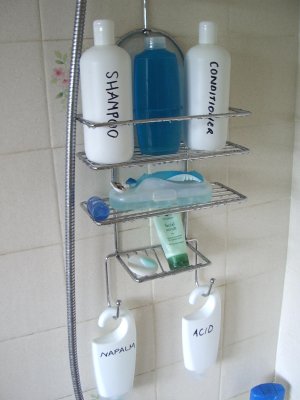
Hey, we thought, wouldn’t it be cool if we peeled the labels off of the Boots Basics shampoo and conditioner and wrote “SHAMPOO” and “CONDITIONER” on them by hand? Then people wouldn’t know that we had bought really cheap shampoo and conditioner, and next time we are in the shop, and we come to our senses, and buy not-so-cheap products, we can refill these bottles, and they will look ace?
And then, I added, we should do the same to the spare bottles of shower gel, but to deter people from using them (because they are supposed to be the spares, you see) we could write “ACID” and “NAPALM” on them instead.
Viola ((for the benefit of the kind of people who find winky smileys useful to figure out if I am trying to be funny or not, this was an intentional (and hilarious) mis-spelling.)).
The title is slightly misleading, but you will admit that it is highly attention-grabbing. With a bit of luck, by the end of this tale you will understand the relevance.
Before I commence my divulsion of this marvellous tale, one that will amaze you like none that you have read before it, it is necessary that I give you some background information, an insight into my daily life that will be central to our story, though in a quite small way.
**The Preamble**
Karen and I maintain a collection of approximately twenty VHS video cassettes, purchased blank, which form our Dynamic Video Collection. They are labelled with small stickers containing a unique identifier (rather than adopting an overly complicated system, we decided that numbering them from 1 to 20 would probably be sufficient for our needs). Accompanying these number tapes is a narrow notebook. Each tape has a corresponding page in the book, which is used to record the name of the film(s) currently recorded on that tape. In the event that we like a film enough to keep it, the numbered sticker is removed from the tape, and replaced by a label containing the film title. This number will remain unallocated until the next shopping trip. You can probably see how the entire system results in hitherto unexperienced quantities of Pure Awesome.
**The Actual Story: Prologue**
On Wednesday, I think it was Wednesday, I was reading the back page of the newspaper at work. Oh look, I said to no-one in particular, my favourite film is on tonight. My favourite film in the world. What film is that said someone. I said Showgirls and we all guffawed like primates.
**The Actual Story: The Actual Story**
“Would you like to watch a film, darling?” my dear lady Karen asked me on Sunday afternoon.
“In a second, my love, my loaf, I am currently checking how my stocks are doing on the Internet, my love.” I replied.
“Smashing.” she said.
Not long after that I was downstairs, leafing through the book of films.
“Panic Room?” I said with gusto.
“Oooh, Panic Room” she said.
“Tape 1 then.” I said.
And she said “Oh. Were you actually enthusing, or just giving me the list?”
I said, “I’m just intending to read out all the titles with gusto, rather than drably reciting them to you as a dull monotone spectacular.”
I proceeded to read out all the titles with gusto. And then I got to the page corresponding to tape 13. I suppose we could call it page 13, though it probably isn’t precisely the 13th page, partly because nobody really has a standard definition as far as page numbering goes. Is the cover page 1? Or page 0? Or page -1?
“Holy fuck!” I said, or something like it. “Showgirls!”
Well, apparently I had actually set the tape for it, but I think I was just following instructions and hadn’t actually been told what I was recording.
“Is it good?” she said.
“Is it good?” I repeated back to her, in that way that people do when they are really winding up for a heartfelt enthuse.
“Not really” I said, “but it is the sort of film that you have to see. It’s essential.”
So we watched it.
Oh boy, what a film. The boobie count is magical. Some of the boobies are really nice, but I don’t fancy Elizabeth Berkeley’s much though. Had to watch the pool scene twice though. That moment where she falls backwards and flops around like a live fish on a chopping board just paralyses me with the giggles.
This is a real no-holds-barred classic. If there was an opportunity to put some obvious titillating moment in, the makers really went for it. Missed by a mile, of course. The fish-on-chopping-board scene is capable of undermining even the most “hardened” of viewers, if you get my drift.
So, in conclusion, lots of tits, zero plot, totally unarousing. The only entertainment value comes from the hilarity of watching such drivel.
Still, it’s essential viewing.

Some people fiddle with their phone when they are in a pub, and their friend has gone to the bar or toilets. I like to whip my camera out and take photos instead.


This was an item of tat on sale on Murano. We were interested at first, until we discovered that the five euro price tag actually applied to the small piece of garbage next to it. We made subtle our escape.

Karen silhouetted against pretty pretty lagoon.
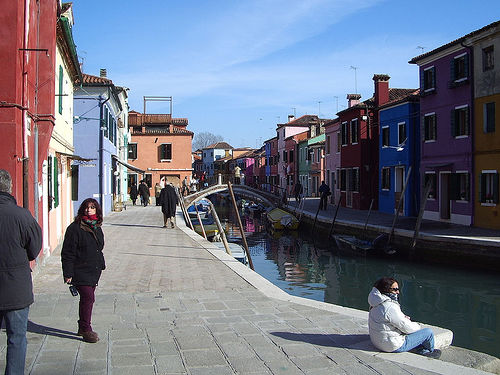
Burano is famous for the pretty multicoloured houses.

Taken from Murano. One of those moments when I marvel pretentiously at the magic of the laws of physics, simplicity and complexity in the same place, and all that.
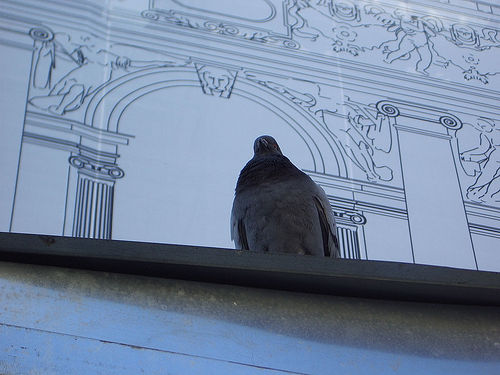
A pigeon in St Mark’s Square. Behind the pigeon is a canvas draped over an enormous scaffolding, to try and make the thing less hideous.

I like pigeons. Their plumage makes for good photos. And they are daft as feathered brushes. Incidentally, the number of pigeons in St Mark’s Square was phenomenal – like Trafalgar Square used to be, in its prime.

One of those photos that everyone takes. The Rialto Bridge, I mean. Not the top of Karen’s head. I don’t think that many people have taken photos of /that/
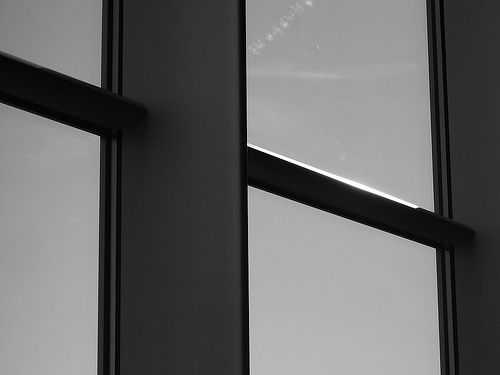
I was a bit bored in the airport so I got arty.
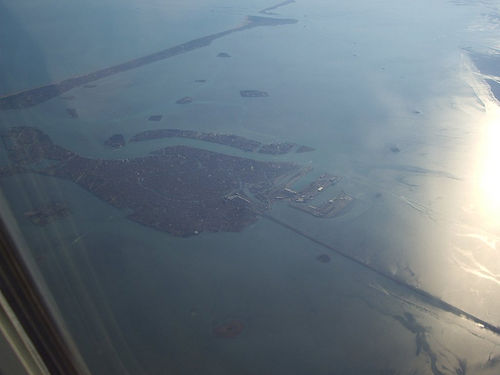
I took this photo from the plane as we were leaving Venice, circling around the north of the island.
I have been meaning to switch to Linux for a long, long time now. The first time that I attempted to do anything about it was about three years ago, when I obtained the Mandrake 8.2 installation CDs (I had to order them through the mail, as I was still on dialup). The installation went okay (apart from the fact that I got confused when partitioning the hard drive, and ended up leaving a megabyte of free space on the Windows partition instead of a gigabyte (or something like that)) but when I got to first boot, there were two deal-breakers.
It didn’t detect my modem, and it didn’t detect the soundcard built into the motherboard.
The absence of the latter wouldn’t have been a problem, but the fact that I couldn’t get onto the Internet meant that trying to fix these two problems seemed like an enormous undertaking.
Of course, when I realised that my Windows partition was now unusably crowded, I had to reformat the whole thing. This put me off of switching to Linux for a few years, and I decided to make do with Windows for a while. It’s not perfect, but at least it works (or appears to, at least).

People often stop me in the street and say “Hey, Pete. Should I leave my computer on all the time, or turn it off when I’m not using it?”
Well, here are your answers. Once and for all. Real facts coming your way…
Q. *Won’t leaving my computer on all the time consume lots of power?*
A. Depends. If you left it working flat out on mathematical calculations, then yes – over £100 per year. If you leave it doing nothing with the monitor switched off, then about £15 per year. If you put it into “hibernate” mode, then it will consume sufficiently little power to be insignificant.
Q. *Doesn’t turning it on and off wear out the components?*
A. Yes, to an extent. However, you’d have to turn it on and off about a dozen times a day, every day to see any difference. The additional stress caused by turning it on and off twice per day isn’t significant enough to be worth considering as a factor.
Q. *Does leaving it on all the time wear out the components?*
A. Again, if you leave it on all the time when you aren’t using it, then you will shorten the life of the components, but really not by much at all. Very few home computers actually die because the components wear out – they are normally just abandoned because they become laden with spyware, junk or trojans, or they are replaced for a better model. Don’t let component life worry you.
Q. *So give me a good argument against leaving it on all the time.*
A. As long as you turn off the monitor to conserve power, the only argument I can think of is that while the computer is turned off, it can’t be attacked by miscreants. But then, as long as you’ve got a decent firewall, you shouldn’t really let that worry you.
Q. *In conclusion?*
A. Really, you can do what you like. As long as you aren’t bothered about £20 per year, there are no convincing arguments one way or the other. If you find yourself turning the computer on more than twice per day, then it may be worth leaving it on. Don’t leave the monitor on – that can waste a lot of electricity. If you want to save more energy, use hibernate mode.
Q. *Where do the numbers come from?*
A. A computer running at full pelt is about 200 watts, or 0.2 kilowatts. There are 8766 hours in the year. 0.2 * 8766 = 1753.2 kilowatt-hours. At 6p per kWh, we get £105.20 per year. When idling with the monitor switched off, the computer consumes about 30 watts, which is about 263 kWh in a year. This comes out at £15.78. These are only rough estimates, based upon an average computer and an average electricity tariff.
Q. *Thank you. I shall not take these figures as gospel. I shall just use them to get a rough idea.*
A. That’s the spirit.
**UPDATE:** As Lyle rightly points out in the comments, computers don’t like power cuts. Shame on me for omitting to mention this. If you live in an area with an unreliable power supply, then you should turn your computer off when you aren’t using it (though I expect that if you are in this situation then you have already bought a laptop). Also, if there is a storm brewing and you think that the power may go out, turn your computer off, switch it off at the wall, unplug it from the mains, and put the plug on a non-conductive surface (like plasticene or velvet).
**2008 UPDATE:** The numbers, of course, are prone to change. Three years later, electricity costs twice as much, and I found that my current computer draws about 70 W when idle. £15 becomes £50.
*This was originally written in my diary, and copied over sometime in 2008*
I still have thoughts, you’ll be pleased to discover. They just come to me at a different time. Instead of materialising when I am sat in front of a computer, they come at night and haunt me in the darkness, terrorising the very core of my being.
Just thought I’d share the good news.